Zano: Privacy Infrastructure for the Counter-Economy
It took me long enough to give Zano the attention it deserves. You can’t really blame me for that — there are many interesting projects building valuable agorist tools for the counter-economy and a single person can’t know everything about anything. Our time is limited.
The good part is: I took the time to look at Zano and write this article so you can have an easy first contact with the infrastructure powering this beautiful project.
In a world where every bank transfer, card swipe, and digital payment leaves a permanent trail for the state to follow, the need for tools that restore private exchange has never been greater.
Governments expand financial surveillance under the banners of “anti-money laundering” and “tax compliance,” while inflation and capital controls punish ordinary people simply for trying to preserve their wealth or trade freely.
Agorists have long understood that the most effective path to liberty is not petitioning rulers but building parallel systems that operate outside their reach. Zano is one of those systems.
It is not merely another privacy coin. It is an open-source Layer-1 blockchain designed from the ground up so that every transaction, every asset, and even the type of asset being transferred remains hidden by default. In the words of its own mission: no surveillance, no intermediaries, no compromise.
A Full Private (Counter-)Economy
Zano was launched in 2019 by Andrey Sabelnikov, the same developer who created the original CryptoNote reference implementation that later became the foundation for Monero and dozens of other projects.
It is NOT a CryptoNote fork, though. The team rebuilt from scratch with a broader vision: a complete infrastructure for the private economy. Think of it as Monero-level privacy combined with the ability to issue private assets and build private marketplaces.
At the protocol level, Zano hides three things that transparent blockchains expose: the sender, the receiver, and the amount. It goes further still by also concealing the asset type.
This is achieved through d/v-CLSAG ring signatures, stealth addresses, and Bulletproofs+. The result is strong fungibility. As in, every unit of ZANO is identical and cannot be tainted or blacklisted.
When transactions are invisible, they cannot be selectively blocked or reversed. That is the practical definition of “censorship resistance,” which has slowly turned into only a narrative for many so-called cypherpunk projects.
The network runs a hybrid Proof-of-Work and Proof-of-Stake consensus. The PoS component, called Zarcanum, is the first of its kind: stakers secure the chain without revealing their balances. This is really groundbreaking and one of the most relevant challenges for PoS privacy I’ve commented on in other occasions.
There are no minimum stakes, no lock-up periods, and no privileged validator class. Anyone can participate.
The core software is written in C++, with developer libraries available in TypeScript, Dart/Flutter, and native C++ for those who want to build applications on top of it.
Most importantly, Zano supports Confidential Assets. Anyone can issue their own private tokens or stablecoins that inherit the exact same privacy guarantees as the native coin. The project’s own private stablecoin, FUSD, demonstrates the point: users can send dollar-denominated value without broadcasting how much, to whom, or when. Wow.
And before you blame me for getting excited about using dollar-pegged coins…
Well, I live in a country (Brazil) with a fiat currency that is worse than the dollar in State control and debasement. Using the dollar as a unit of accounting is a significant life improvement for me. Even more so, doing it in a decentralized network, using self-custody wallets, and in a privacy infrastructure makes it the very definition of an agorist tool as far as I’m concerned.
Tools for Counter-Economics
Agorism is not abstract theory. It is the practice of voluntary exchange in the gray and black markets — the counter-economy that undermines the state’s monopoly on money and trade. Zano supplies concrete tools for that practice.
Zano Trade enables peer-to-peer swaps of any asset using Ionic Swaps, an improvement on atomic swaps that settles entirely on-chain with full privacy and no intermediary. Zano Bay is a private marketplace where goods and services can be bought and sold with end-to-end encrypted transactions. Human-readable aliases (@usernames) replace long addresses, and a decentralized messenger linked to those aliases provides private communication.
Payment infrastructure is already live. Zano Pay and Zano Cash let merchants accept private payments through simple links or embeddable widgets. More significantly, partnerships have brought real-world spending power. Through AEON Pay, ZANO and FUSD can, theoretically, be spent at tens of millions of merchants across emerging markets via QR codes and local bank rails. I’ve yet to test AEON.
Zebec integration allows loading a Mastercard that works wherever the card network is accepted (also theoretical for me — I didn’t test it yet). In each case the user retains the privacy of the Zano chain while the merchant receives local currency.
Where Adoption Is Happening
The strongest early traction has appeared precisely where state money fails most visibly: emerging markets suffering from high inflation, capital controls, and unreliable banking systems.
Community groups in Brazil (my case), Nigeria, Venezuela, Indonesia, and elsewhere have grown through workshops, local contests, and merchant outreach. In Africa alone, Telegram and WhatsApp communities have expanded rapidly, with participants creating on-chain aliases and Confidential Assets during live events.
AEON Pay’s coverage already includes Brazil, Nigeria, Kenya, Zambia, Vietnam, the Philippines, Mexico, and additional countries in Latin America and Southeast Asia. These are regions where QR and mobile-money payments dominate everyday commerce (Pix has grown strongly in Brazil) and where formal financial channels often extract high fees or impose restrictions.
Privacy-preserving digital cash that can settle into local currency meets a genuine need. Believe me, I know. I’ve been living 100% on a crypto standard since 2023, in addition to producing technical content and helping the team with documentation and DevRel initiatives through thecoding.dev for more than six years.
Looking Forward
As of mid-2026, the Zano network has processed nearly six million transactions, with a large majority of the circulating supply actively staked. Fees are fixed (flat 0.01 $ZANO) and entirely burned. The project continues to expand bridges and developer tools while preparing further upgrades that improve usability for exchanges and services without sacrificing user privacy.
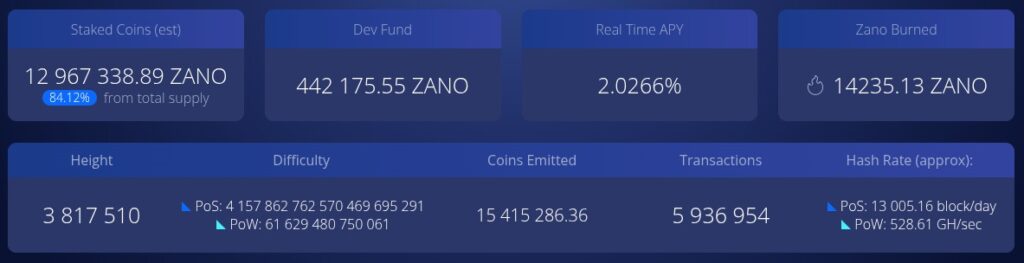
The 100% fee burn creates an interesting economic dynamic. If this burn surpasses emission and vesting unlocks, ZANO can eventually become a deflationary asset. This built-in tokenomic adds long-term scarcity to the equation, which can contribute to ZANO’s purchasing power increasing over time (translated to: number goes up).
For agorists, however, the value is not in short-term price action. It is in the existence of a working platform where private, voluntary exchange can scale. Transparent ledgers create permanent records that states and corporations can later exploit. Zano refuses to create those records. This is invaluable.
The counter-economy has always needed better tools. Cash is limited by physical distance and bulk. Most cryptocurrencies still lack privacy (crazy, right?). Zano brings privacy to the infrastructure level and then layers practical applications — trading, marketplaces, stable value, real-world spending — on top of that foundation.
Those who want to experiment can download the official desktop or mobile wallets, explore Zano Trade, or test payment links. The code is open-source. The network has been running continuously since 2019. No one needs to ask for permission to participate.
In the end, agorism is measured by results: more voluntary transactions that the state cannot see, tax, or stop. Zano is one of the clearer attempts yet to give people the infrastructure for exactly that.

Vini B
Vini B is an agorist technical writer and docs engineer working in blockchain and crypto for 6+ years, currently offering services via thecoding.dev via crypto payments. Vini also posts technical content on X at [@vinibarbosabr](https://x.com/vinibarbosabr) and on Substack at [thecoding.substack](https://thecoding.substack.com).*